
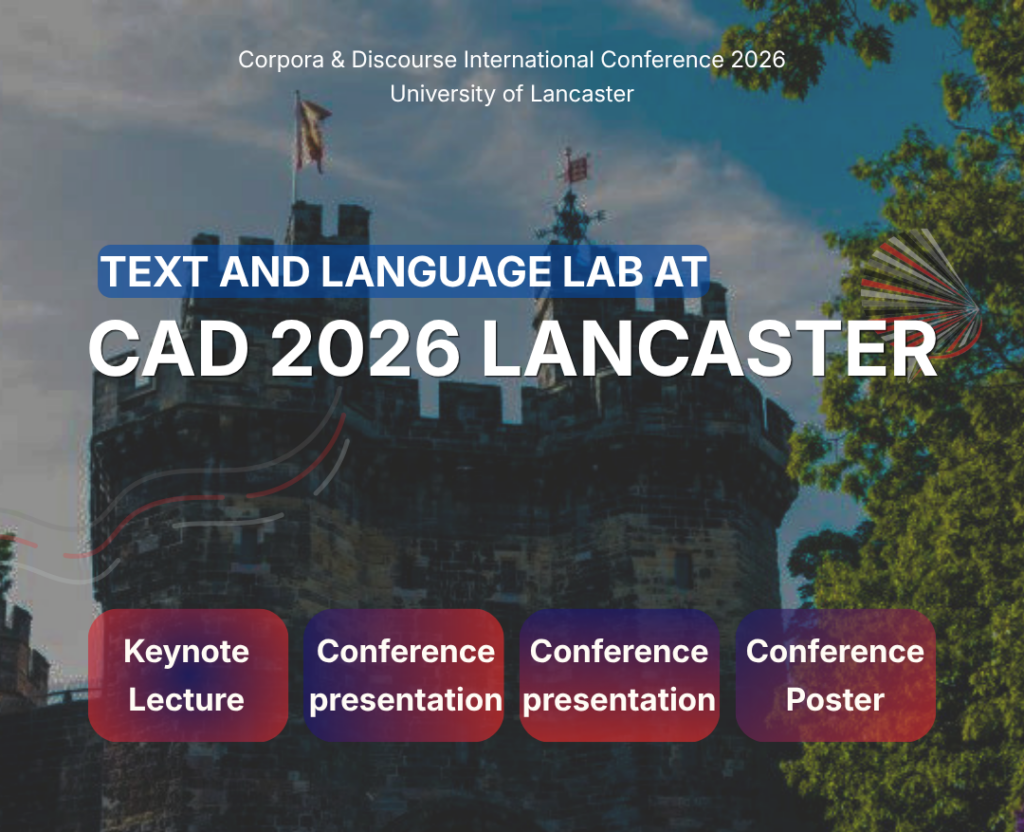
The Text & Language Lab team took part in the 8th Corpora and Discourse International Conference (CAD 2026), held at Lancaster University, UK, from 23–25 June 2026. CAD 2026 brought together researchers from across the world working at the intersections of corpus linguistics and discourse analysis, with contributions spanning corpus-assisted discourse studies, corpus-based and corpus-driven approaches, corpus stylistics, corpus pragmatics, sociolinguistics, contrastive linguistics and related areas of research.
For the Text & Language Lab, CAD 2026 was an especially exciting occasion. Members of the Lab presented work on political discourse, literary fanfiction, environmental fiction and video game narratives, demonstrating the wide range of questions that corpus-based methods can help us investigate.
Discourses and Transdisciplinarity
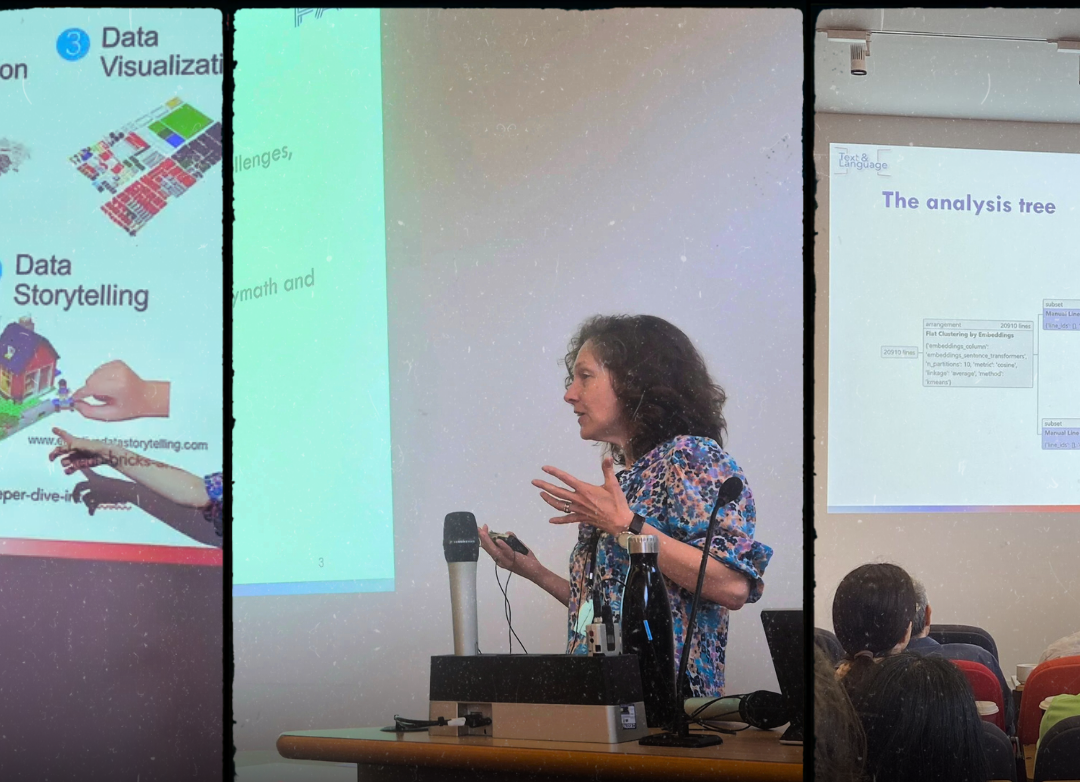
One of the highlights of the conference was Michaela Mahlberg’s plenary talk, “Discourses and Transdisciplinarity.” The talk reflected on how corpus data can be understood as evidence of human experience and how the study of discourse opens up opportunities for working across disciplines.
The plenary addressed both the promises and the challenges of transdisciplinary corpus linguistics. It showed how discursive problems often extend beyond disciplinary boundaries and how corpus-based approaches can contribute to research in areas such as environmental sciences, digital humanities, literary and cultural history, and AI-related debates.
Nathan Dykes: Quotation in German Parliamentary Debates
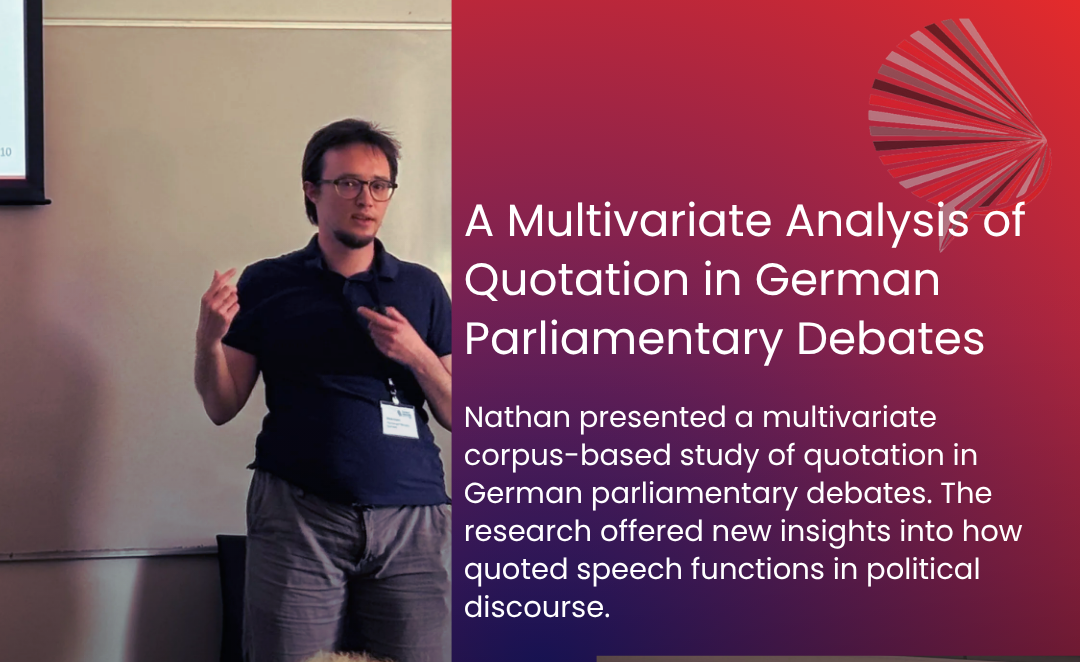
The paper examined how verbatim quotation functions in parliamentary discourse. Parliamentary debates are a hybrid genre: they are spoken, but also highly planned, institutionally regulated and often directed not only at fellow parliamentarians but also at wider public and media audiences.
Nathan’s study focused on quotation in the GermaParl corpus of German parliamentary discourse. Using corpus queries, he extracted quotations and annotated them for features such as the type of actor being cited, syntactic form, reporting expressions and explicit markers such as ich zitiere / “I quote”.
The analysis used multiple correspondence analysis to identify patterns in how these features co-occur. The results showed that different quotation practices are associated with different rhetorical and discourse functions. Some quotations foreground literary or cultural authority, while others connect parliamentary talk to contemporary media voices, institutional procedure or political positioning.
The presentation demonstrated how multivariate corpus methods can reveal systematic patterns in political discourse that may be difficult to identify through isolated qualitative examples alone.
Nathan Dykes and Anastasia Glawion: Body, Movement and Sensation in Jane Austen Fanfiction
Nathan also presented collaborative work with Anastasia Glawion on “Body, movement and sensation in fanfiction on Jane Austen.”
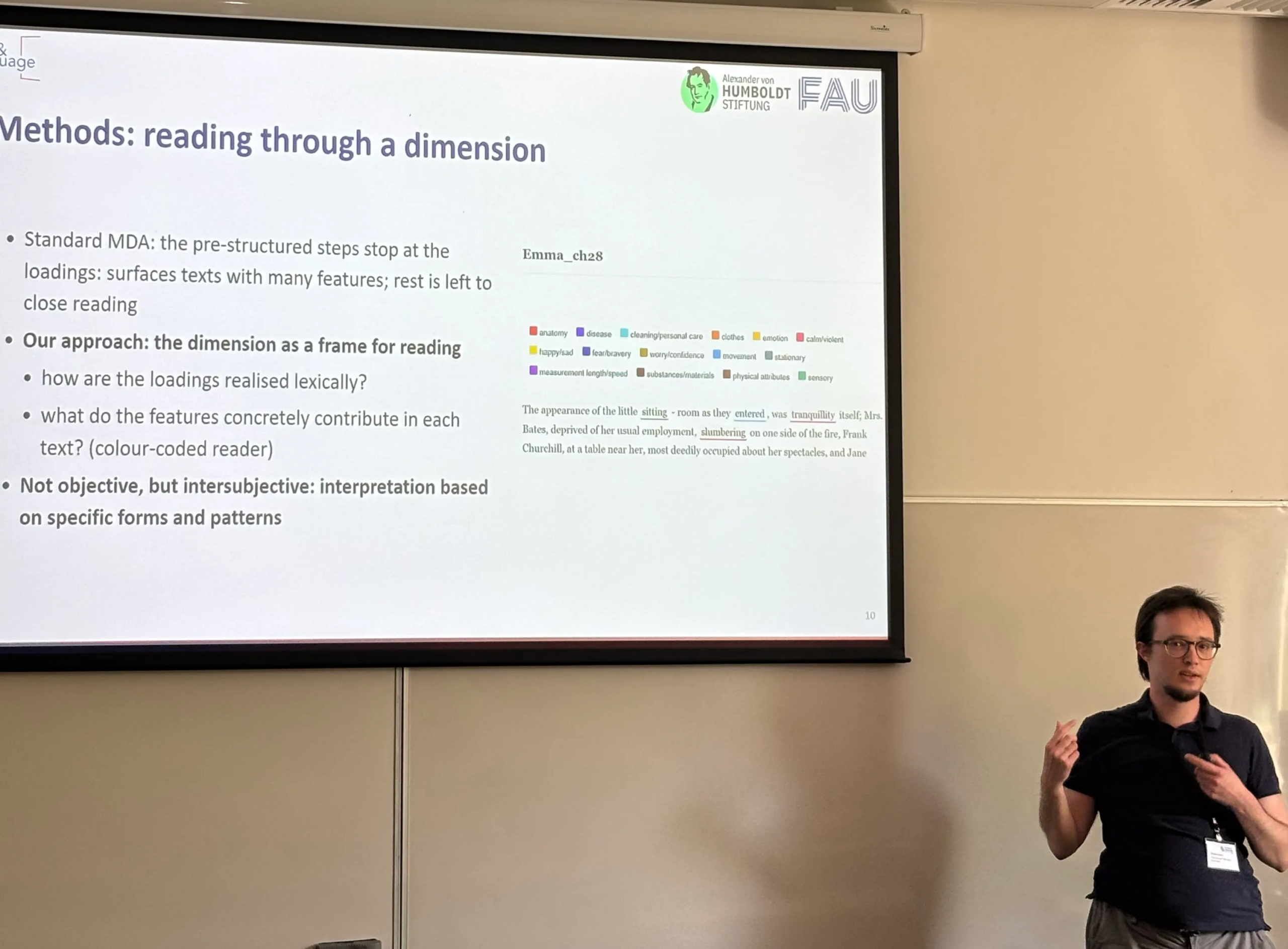
This paper explored how bodies are represented in Jane Austen fanfiction compared with Austen’s own novels. The study compared a corpus of Austen’s six novels with a collection of Austen-based fanfiction stories from AO3, using corpus linguistic methods to examine references to anatomy, physiology, sensation and movement.
The project focused on how fanfiction continues, transforms and reimagines literary worlds. While Austen’s novels and fanfiction share some patterns of bodily reference, the analysis found important differences. Fanfiction tends to foreground more concrete body parts, intimate physical contact, sensory language and dynamic character movement. Austen’s writing, by contrast, often uses more indirect, metaphorical or conventionalised bodily references.
The paper showed how corpus methods can contribute to the study of literary reception and adaptation. By comparing canonical literature with fan writing, the research opened up new ways of understanding how readers and writers engage creatively with literary heritage.
Andreas Wagner: The Human–Water Relationship in 19th-Century Fiction
Andreas Wagner presented his work on “The human-water relationship in 19th century fiction.”
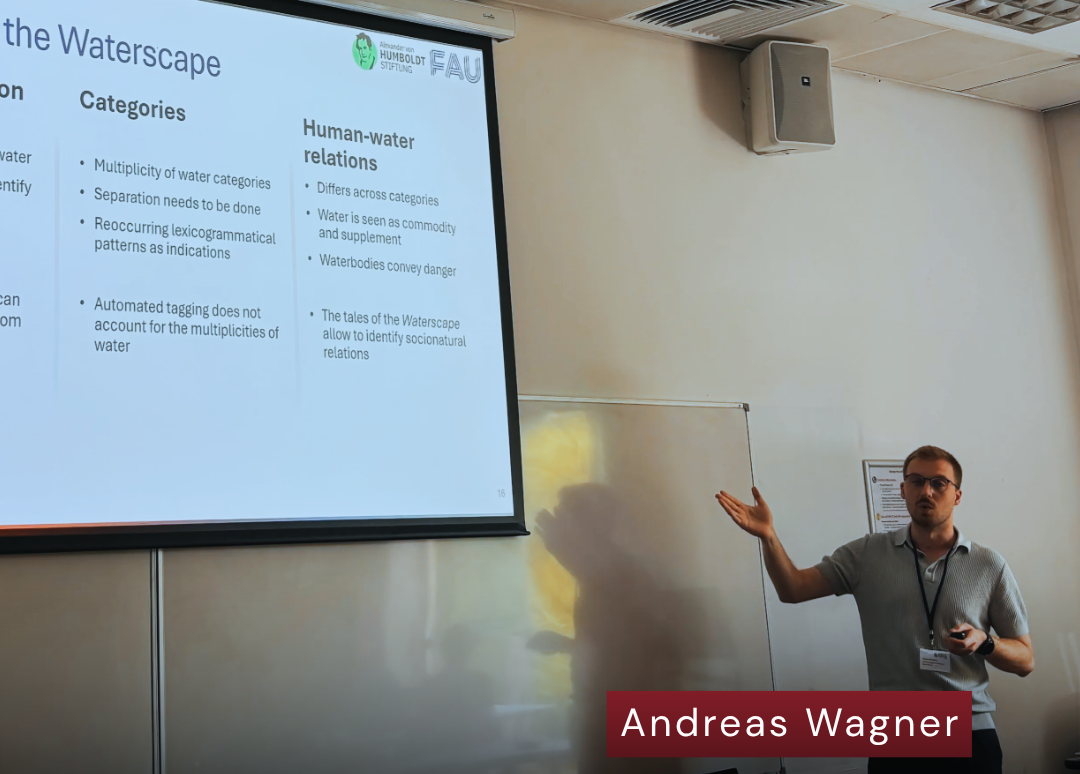
The paper considered how 19th-century fiction can help us understand cultural narratives about humans and water. Against the backdrop of climate crisis, water scarcity and environmental uncertainty, the study asked what kinds of “base narratives” about the human-water relationship are present in literary fiction.
The analysis drew on a corpus of Charles Dickens’s novels and a broader 19th-century reference corpus, covering 44 novels in total. The study used semantic tagging and references to spatial and environmental features, including rivers, boats and other water-related terms, to identify candidate sentences for qualitative analysis.
The findings suggested that water extremes do not dominate these fictional texts. Instead, waterbodies and domestic water emerge as important parts of the narratives through which humans are positioned in relation to their environment. The study showed how literary fiction can provide insight into historical ways of imagining water, place and human-environment relations.
This presentation connected corpus linguistics with environmental humanities and demonstrated how literary discourse can contribute to broader conversations about climate, narrative and uncertainty.
Janno Reincke: Analysing Multimodal Narratives in Video Games
Janno Reincke presented a poster titled “Analysing Multimodal Narratives in Video Games.”
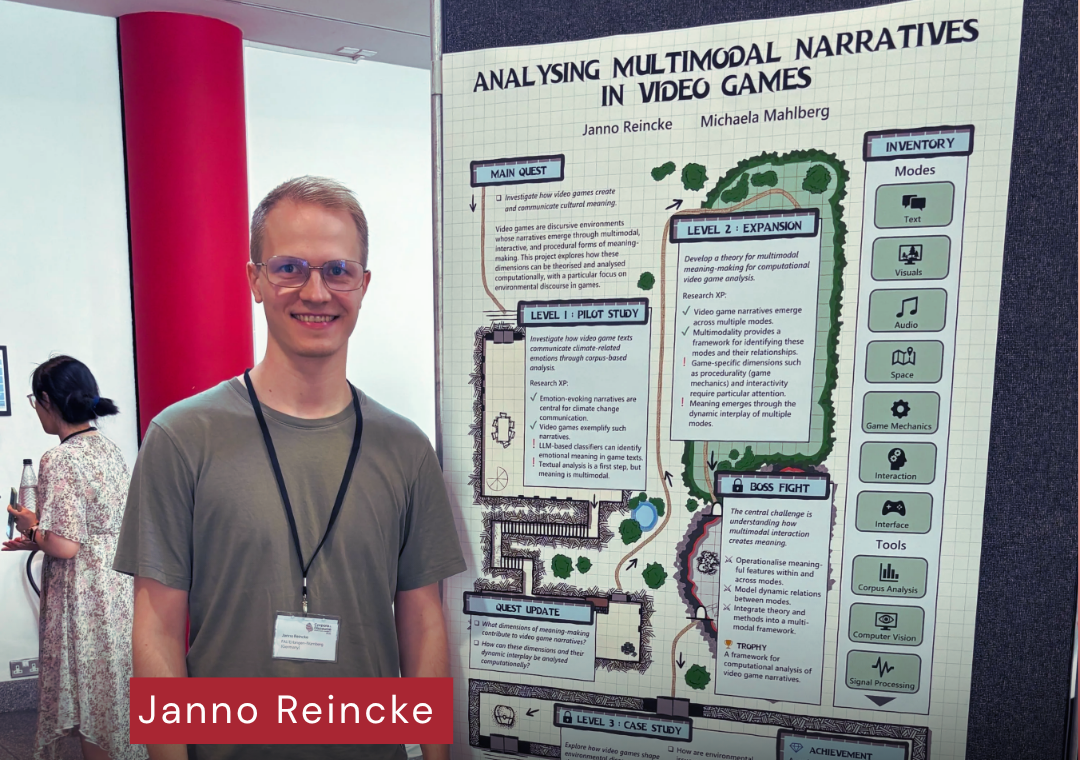
The poster outlined the research trajectory of his PhD project. His work explores video games as discursive environments that contribute to individual and cultural meaning-making. As multimodal media, video games communicate meaning not only through written and spoken language, but also through visuals, music, game mechanics and player interaction. Building on this perspective, the project aims to develop a multimodal computational approach to analysing video games, with a particular focus on environmental narratives and discourse.
Janno’s poster received a warm response from fellow researchers, with one comment describing it as a “very creative poster design, so suitable for the topic.” The project highlights the potential of computational and corpus-based approaches for studying multimodal and interactive media.
You can download the poster here:
- File Name
- Reincke_A0_Poster
- File Size
- 4 MB
- File Type
Licensed under a Creative Commons Attribution–NonCommercial–NoDerivatives 4.0 International Licence (CC BY-NC-ND 4.0).
Reflections from CAD 2026
CAD 2026 was a valuable opportunity to reflect on the diversity and future direction of corpus and discourse research. The conference showed how corpus methods can be applied to a wide range of topics, including politics, literature, environmental discourse, digital media, online communication and multimodal meaning-making.
The Text & Language Lab contributions reflected this diversity. Across the presentations and poster, Lab members explored how language constructs political authority, literary embodiment and human-environment relations.
A strong theme running through the conference was transdisciplinarity. Many talks and discussions showed that corpus linguistics is increasingly being used to address questions beyond linguistics alone. Whether applied to parliamentary debates, fanfiction, 19th-century novels or video games, corpus-based approaches offer powerful ways of tracing patterns in language and connecting them to wider social, cultural and communicative contexts.
Looking ahead
The Text & Language Lab leaves CAD 2026 with new ideas, new connections and renewed energy for future research. The conference offered many inspiring examples of how corpus and discourse studies continue to develop, especially through engagement with new data types, new technologies and new interdisciplinary questions.
We are grateful to the organisers, speakers and participants for creating such a stimulating and welcoming conference environment at Lancaster University. We look forward to building on the conversations started at CAD 2026 and continuing to explore how language, text and discourse shape the worlds we study.