
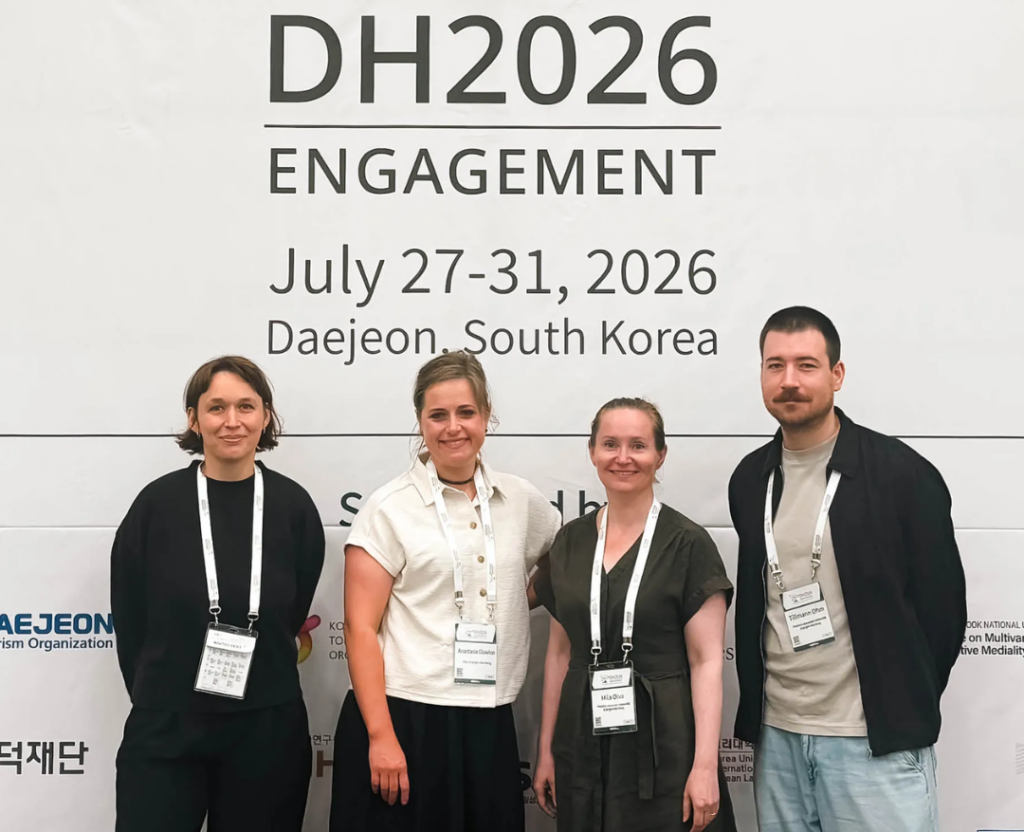
From 27 to 31 July 2026, colleagues from the Department of Digital Humanities and Social Studies (DHSS) joined the international Digital Humanities community in Daejeon, South Korea, contributing to the AVinDH Special Interest Group’s pre-conference programme and presenting research across audiovisual analysis, computational literary studies and digital social research.
The 36th annual Digital Humanities conference of the Alliance of Digital Humanities Organizations (ADHO) took place at the Daejeon Convention Center under the theme “Engagement.” DHSS colleagues contributed to both the pre-conference programme and the main conference, highlighting the breadth of research at FAU at the intersection of culture, computation, images, texts and digital media.
AVinDH: reflecting on the past, present and future of audiovisual Digital Humanities
-
The AVinDH workshop celebrated ten years of audiovisual Digital Humanities through discussions, lightning talks and tool demonstrations at DH2026 in Daejeon.
-
Prof. Mila Oiva co-convened the workshop, bringing researchers together to reflect on the past, present and future of audiovisual Digital Humanities.
-
Tillmann Ohm presented EIDORA, an open-source application for exploratory visual analysis of embedding spaces and heterogeneous cultural materials.
-
Lauren Tilton joined the anniversary panel as a discussant, reflecting on the development and future directions of the AVinDH community.
-
Michaël Bourgatte contributed to the anniversary panel, discussing ten years of audiovisual Digital Humanities and the community’s evolving research practices.
-
Yumeng Hou participated as a discussant in the anniversary panel, exploring the past, present and future of the international AVinDH community.


DHSS research in the DH2026 main conference
DHSS was also represented through three research contributions in the main conference programme on Thursday, 30 July.

Nostalgia in alt-right social media: Truth Social.
Prof. Anastasia Glawion and Mykola Makhortykh contributed the paper “Nostalgia in alt-right social media: Truth Social.” The study brings computational and Digital Humanities perspectives to the examination of nostalgia in contemporary right-wing social-media environments. The paper was part of the long-paper programme in Session S040.
Letting the Cat out of the Bag’: Towards the Automatic Detection of Animal Metaphors in Literary Texts.
Katrin Rohrbacher presented “‘Letting the Cat out of the Bag’: Towards the Automatic Detection of Animal Metaphors in Literary Texts.” The project explores how computational approaches can contribute to identifying and analysing animal metaphors in literary texts.


Detecting Perestroika in Poses from Soviet Newsreels, 1980 to 1990
A further contribution by Peter Broadwell and Prof. Mila Oiva, “Detecting Perestroika in Poses from Soviet Newsreels, 1980 to 1990,” examined audiovisual historical material through computational analysis of bodily poses. The paper forms part of Oiva’s broader research into historical newsreels, audiovisual heritage and computational approaches to visual culture.
Connecting methods, media and communities
Taken together, the DHSS contributions to DH2026 ranged from audiovisual archives and visual embedding spaces to literary metaphor and social-media discourse. They demonstrate the methodological diversity of Digital Humanities at FAU and the department’s engagement with international research communities across textual, visual and audiovisual scholarship.
DH2026 also provided an opportunity to exchange ideas with colleagues from around the world, discuss emerging computational methods and tools, and develop new connections across disciplinary boundaries.
We thank the DH2026 organisers, the AVinDH community, our collaborators and all participants for the inspiring conversations in Daejeon.